Three-act structure: how to plot your story
Three-act structure divides a story into a beginning, middle and end, each with a clear job. It's the most widely used framework for novels and screenplays because it matches how audiences experience tension and release.
Act One: setup (about the first 25%)
Introduce the main character, their world and what they want. Then comes the inciting incident, the event that disrupts normal life. Act One ends when the character commits to the journey and can't easily turn back.
Act Two: confrontation (about 50%)
The longest act. The character pursues their goal and meets rising obstacles. At the midpoint something shifts: a revelation, a reversal or a change from reacting to acting. Pressure builds to a low point near the end of the act, where everything seems lost.
Act Three: resolution (about 25%)
The character, changed by what they've learned, makes a final push. The climax is the decisive confrontation, followed by a resolution that shows the new normal. Strong endings answer the story's central question in a way that feels surprising but inevitable.
Key beats at a glance
- Opening image or hook
- Inciting incident
- Point of no return (end of Act One)
- Midpoint
- Low point (end of Act Two)
- Climax
- Resolution
The shape of a three-act story
Drawn as a line, a three-act story rises in steps. Each turning point raises the stakes, the midpoint changes the direction, and tension peaks at the climax before falling away in the resolution.
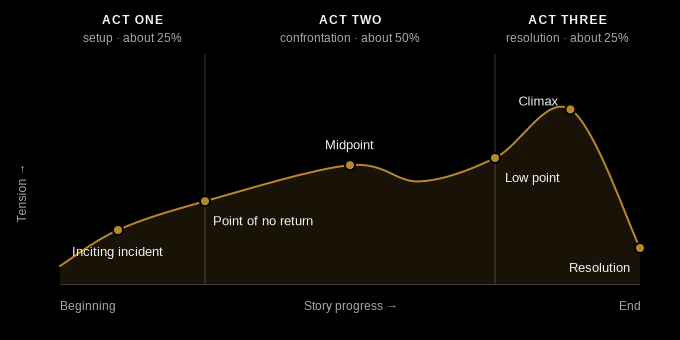
Treat the percentages as a guide. A thriller may reach its inciting incident on page one; a literary novel may take a third of the book to arrive at its point of no return. What matters is that each beat happens, in this order, and that the climax answers the question the inciting incident asked. For a classic five-part version, see Freytag’s pyramid in how to write a short story.
Other structures
The Hero's Journey describes a mythic cycle of departure, trials and return. Save the Cat, from screenwriter Blake Snyder, breaks a story into 15 beats. Kishōtenketsu, a four-part structure from East Asian storytelling, builds through contrast rather than conflict. All of them are tools; use the one that helps you see your story. See also how to outline a novel.
The 15 beats of Save the Cat
Blake Snyder's beat sheet divides the three acts into fifteen steps. Novelists use it as a checklist:
- Opening Image, Theme Stated and Set-Up: the hero's world before the change.
- Catalyst and Debate: something happens, and the hero hesitates.
- Break into Two: the hero chooses to act.
- B Story and Fun and Games: a new relationship, and the premise delivering what it promised.
- Midpoint: a false victory or false defeat that raises the stakes.
- Bad Guys Close In, All Is Lost and Dark Night of the Soul: pressure, collapse and despair.
- Break into Three, Finale and Final Image: a new idea, the last battle and the changed world.
The Hero's Journey
Joseph Campbell described a pattern shared by myths in The Hero with a Thousand Faces in 1949: a hero leaves the ordinary world, faces trials, and returns changed. The screenwriter Christopher Vogler later turned it into twelve practical stages, from the Call to Adventure to the Return with the Elixir. It suits quests and coming-of-age stories especially well.
A structure without conflict
Kishōtenketsu, used in classic Chinese, Korean and Japanese storytelling, has four parts: introduction, development, twist and reconciliation. The third part brings in something unexpected, and the fourth shows how it connects to what came before. Nothing has to be fought over, which makes it a useful model for quiet stories.
Where Ixonian fits in
Ixonian is being built for writers who want to share their stories and readers who love a well-told one. Pre-register to follow along. Pre-register free.
Frequently asked questions
Do all stories need three acts?
No, but most satisfying stories have a setup, escalation and payoff, whatever you call them.
Where should the inciting incident happen?
Usually within the first 10 to 15% of a novel, early enough to hook readers.
Is three-act structure formulaic?
Only if used rigidly. It describes the shape of tension; the content is up to you.
Which structure should a beginner use?
Three acts with a clear midpoint is enough. Add a beat sheet if your middle sags.