How to write a short story
A short story isn't a small novel. It focuses on a single moment, change or revelation and gets in and out quickly. That compression is what makes short stories such good practice, and such a pleasure to read.
How long is a short story?
Definitions vary, but short stories usually run from about 1,000 to 7,500 words. Flash fiction is under about 1,000 words. Science fiction and fantasy awards use 7,500 words as the upper limit for short stories, with novelettes up to 17,500 and novellas up to 40,000. Many magazines prefer stories under 5,000 words.
Focus on one change
Choose a single conflict and a small cast. Ask yourself: what changes for my character between the first line and the last? The change can be big (a decision, a loss) or quiet (a realization), but it should be there.
Structure that works
- Open close to the action, ideally with a hint of conflict in the first paragraph.
- Build tension through two or three escalating moments.
- Reach a turning point where the character must act or understand something.
- End with resonance: a resolution, a twist or an image that lingers. You don't have to explain everything.
Freytag’s pyramid
In 1863 the German novelist and critic Gustav Freytag described the structure of five-act drama as a pyramid, and it still describes most short stories well, compressed into a few thousand words.
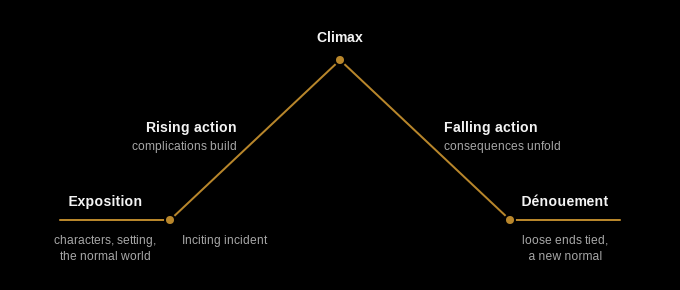
In a short story, the exposition may be a single paragraph and the falling action a single line. Many stories start just before the inciting incident and end soon after the climax, leaving the reader to imagine the rest. For the three-act version used by novelists, see three-act structure, and for the techniques that make each stage work, see literary devices.
Make every word count
With limited space, details must do double duty: a single gesture can reveal both a character and the setting. Cut warm-up paragraphs, backstory dumps and scenes that repeat information, and read the story aloud when revising.
Where to publish short stories
Literary and genre magazines publish short fiction, and many pay. Databases such as Duotrope and The Submission Grinder list markets, pay rates and response times. Always read a magazine's guidelines, and a few stories it has published, before you submit. Contests, anthologies and your own newsletter are other options.
The official lengths
The Nebula Awards, run by the Science Fiction and Fantasy Writers Association, define a short story as fewer than 7,500 words, a novelette as 7,500 to just under 17,500, and a novella as 17,500 to just under 40,000. Other genres are less formal, but magazines use similar bands, and each lists its own limits in its guidelines.
What magazines pay
Pay ranges from nothing to professional rates. In science fiction and fantasy, SFWA counts a market as professional when it pays at least 8 cents a word, which means about $400 for a 5,000-word story. Literary magazines more often pay a flat fee or in copies. Markets that charge a reading fee are common in literary fiction; weigh the fee against the pay and the odds.
Submitting like a professional
- Follow the magazine's guidelines exactly: length, file type and formatting.
- Check whether simultaneous submissions are allowed, and withdraw promptly if a story is accepted elsewhere.
- Track every submission; The Submission Grinder does this free.
- Expect rejections, and send the story to the next market the same day.
Where Ixonian fits in
Ixonian is being built as a home for stories of every length and the writers who tell them. Pre-register to hear first when it opens. Pre-register free.
Frequently asked questions
How many characters should a short story have?
Usually one main character and a handful of others. Fewer characters let you go deeper.
Can I post my story online before submitting it?
Many magazines consider a story published once it's publicly online, so check their guidelines before posting.
How long does it take to write a short story?
A first draft can take an afternoon; revising may take days or weeks.
What rights does a magazine buy?
Usually first publication rights for a set period, after which the rights return to you. Read the contract.