How to self-publish a book
Self-publishing means you're the publisher: you control the content, cover, price and schedule, and you keep the rights. It also means you're responsible for doing it well. This guide walks through each step.
1. Edit professionally if you can
After self-editing and beta readers, consider a developmental editor (story), a copyeditor (sentences) and a proofreader (final errors). If your budget is tight, prioritize a copyedit or proofread. Readers notice errors more than almost anything else.
2. Get a cover that fits your genre
Your cover is your most important marketing tool. It should look at home next to bestsellers in your genre and read clearly as a small thumbnail. See book cover design.
3. Format the interior
Ebooks need a clean, reflowable EPUB; print books need a print-ready PDF with the right trim size, margins and fonts. Tools such as Vellum, Atticus and the Reedsy Book Editor make this easier. See how to format an ebook.
4. Decide on ISBNs
Ebooks on most stores don't require an ISBN, and some platforms offer free ISBNs for print. Owning your own ISBNs lets you be listed as the publisher. See what is an ISBN.
5. Choose distribution
- Direct to stores: Amazon KDP, Apple Books, Kobo Writing Life, Google Play Books and Barnes & Noble Press.
- Aggregators: services such as Draft2Digital distribute to many stores and libraries from one upload, for a small share of sales.
- Exclusive or wide: KDP Select requires ebook exclusivity to Amazon in exchange for Kindle Unlimited income; going wide means selling everywhere.
- Print-on-demand: KDP Print and IngramSpark print copies as they're ordered, with no stock to store.
6. Price, launch and market
Research prices in your genre (see ebook royalties and pricing), plan a launch (see the book launch checklist) and build a long-term readership (see book marketing for authors).
What the professionals charge
The Editorial Freelancers Association's 2026 rate chart, based on a survey of more than 1,100 editors, gives median fiction rates of about 3 to 3.5 cents a word for developmental editing, 2 to 2.7 cents for copyediting and 1.2 to 2 cents for proofreading. For an 80,000-word novel that means roughly $2,400 to $2,800, $1,600 to $2,200 and $960 to $1,600. Few first-time authors buy all three; a copyedit or proofread is the usual minimum.
Print: KDP and IngramSpark in 2026
- Amazon KDP prints and sells paperbacks and hardcovers on Amazon with no setup fee. Since June 2025 it pays 60% of the list price on books at $9.99 or more and 50% below, minus printing.
- IngramSpark reaches bookstores and libraries through Ingram's catalog. Title setup is free, and from February 2026 so are revisions; it charges a market access fee of 1.875% of the list price on books in distribution.
- Many authors use both: KDP for Amazon, IngramSpark for everywhere else. That needs your own ISBN, because Amazon's free one can only be used on KDP.
Choosing a trim size
Before you format a print edition, choose its trim size, the finished page size. Novels are usually printed between 5 × 8 and 6 × 9 inches, and Amazon KDP says 6 × 9 inches is the most common size for US paperbacks.
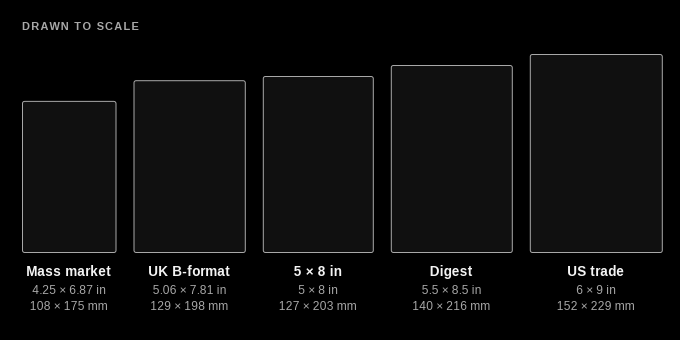
The size changes the page count, the spine width and the print cost, so decide before you design the cover. See book sizes for the full list in inches and millimetres.
DRM is now a choice you can revisit
Amazon used to fix the DRM setting at first publication. Since the end of 2025 authors can change it later, and from 20 January 2026 buyers of DRM-free KDP books can download EPUB and PDF copies. See what is ebook DRM.
Where Ixonian fits in
Ixonian is being built as a home for self-published authors, with a publishing studio, author pages and readers who love discovering indie books. Pre-register to hear first when it opens. Pre-register free.
Frequently asked questions
How much does self-publishing cost?
You can publish for almost nothing, but most authors pay for editing and a cover. Costs vary widely with genre, length and the professionals you hire.
Can self-published books get into bookstores?
It is possible through distributors such as IngramSpark, but bookstores are selective. Most self-published sales happen online.
Do I keep my rights when I self-publish?
Yes. Uploading to a store gives it permission to sell your book; you keep the copyright and can usually unpublish at any time.
Can I use Amazon's free ISBN on IngramSpark?
No. An ISBN from KDP only works on KDP; to print the same edition elsewhere you need your own.