Book cover design: what makes a cover sell
Readers really do judge books by their covers. In a few seconds, a cover has to tell them the genre, the mood and the quality of what's inside. Here's what makes covers work.
Signal the genre instantly
Look at the top sellers in your exact subgenre. Romance, thrillers, epic fantasy and literary fiction each have recognizable color palettes, imagery and fonts. Your cover should look like it belongs in that lineup, with something distinctive that makes it yours.
Design for the thumbnail
Most readers first see your cover as a tiny image on a phone. The title and author name should be readable at that size, the image should be simple and bold, and fine details shouldn't carry the meaning.
Typography matters
- Use one or two typefaces that suit the genre.
- Make the title large and high-contrast.
- Keep the author name consistent across a series to build recognition.
- Avoid default fonts that look amateur.
Sizes and specs
- Ebook: Amazon recommends 2,560 × 1,600 pixels, a 1.6:1 height-to-width ratio, in RGB color.
- Print: a full wrap with back cover, spine and front, sized to your trim size and page count, with bleed.
- Keep important text away from the edges.
- Use high-resolution images (300 DPI at print size).
Images and licensing
Only use images you have the rights to: licensed stock photos, commissioned art or your own work. Check stock licences for print-run limits and merchandise use. If you use AI image tools, check each store's rules and disclosure requirements, and whether the result can be protected by copyright where you live.
Hiring a designer
Pre-made covers are affordable and quick; custom covers fit your book exactly. Share covers you like from your genre, the tone and the key story elements. Ask for the ebook cover, the print wrap and versions for social media.
Three ways to get a cover
- Pre-made: a finished design sold once, with your title and name added. The quickest and cheapest professional option.
- Custom from a designer: built around your book and its genre. Ask for the ebook cover, the print wraparound and the layered source file.
- Do it yourself: possible for typographic covers if you study bestsellers in your genre first. Photographic and illustrated covers are much harder to get right.
Print covers need exact measurements
A print cover is one image containing the back cover, spine and front. The spine's width depends on the page count and the paper, so the cover can only be finished once the inside of the book is laid out. Amazon KDP and IngramSpark each provide a free template or calculator: enter the trim size, page count and paper type, and it gives the exact size including bleed, the extra margin that is trimmed off after printing.
The anatomy of a print cover
A paperback cover is printed as one flat sheet that wraps around the pages: back cover, spine and front cover. The artwork has to run past the trim line into the bleed, so no white edge appears when the sheet is cut, and text has to stay inside the safe area.
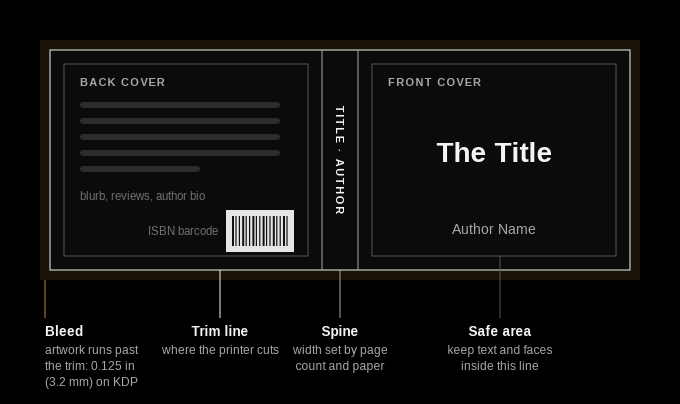
On Amazon KDP, the bleed is 0.125 inches (3.2 mm) on the top, bottom and outside edges, and a book needs at least 79 pages before it can have text on the spine. Spine width is the page count multiplied by 0.002252 inches for white paper or 0.0025 inches for cream. Your printer’s cover template does this arithmetic for you. For page sizes, see book sizes, and for the other parts of a book, see parts of a book.
Test it small
Before approving a design, shrink it to the size of a postage stamp and put it beside the top sellers in your category. If you can't read the title, or it looks like it belongs to a different genre, change it now. A cover is the cheapest thing to fix before launch and the most expensive mistake after it.
Where Ixonian fits in
Covers are front and center on Ixonian, which is being built with shelves and a library designed around book covers. Pre-register to hear first when it opens. Pre-register free.
Frequently asked questions
How much does a book cover cost?
From under $100 for a pre-made cover to many hundreds of dollars or more for a custom illustrated one.
Can I design my own book cover?
Yes, with tools such as Canva or professional design software, but study your genre closely and get honest feedback.
Should the cover show my main character?
It depends on the genre. Some genres favor characters; others favor objects, symbols or bold typography.
Can I change my cover after publishing?
Yes. Uploading a new cover is free on Amazon KDP, and since February 2026 IngramSpark no longer charges for revisions either.