Parts of a book: front matter, body and back matter
Open almost any book and you will find the same parts in the same order, a tradition printers settled centuries ago. Here is every part, from the half title to the index, what each one is for, and which ones a self-published book really needs.
The three main divisions
Publishers divide a book into three parts. The front matter comes before the story or main text and introduces the book. The body is the text itself. The back matter follows it with supporting material. Front matter pages are traditionally numbered with roman numerals (i, ii, iii), and arabic numbering starts again at 1 with the body.
Front matter, in order
Few books have every part. This is the traditional order, following the conventions in The Chicago Manual of Style:
| Part | What it is | Needed? |
|---|---|---|
| Half title | A page with only the title, before the full title page | Optional, common in print |
| Also by | A list of the author’s other books | Useful for series authors |
| Title page | Title, subtitle, author and publisher | Yes |
| Copyright page | Copyright notice, edition, ISBN, credits, on the back of the title page | Yes |
| Dedication | A line dedicating the book to someone | Optional |
| Epigraph | A short quotation that sets the tone | Optional |
| Table of contents | Chapters and their page numbers or links | Yes for ebooks and non-fiction |
| Foreword | An introduction by someone other than the author | Optional |
| Preface | The author on how or why the book was written | Optional |
| Acknowledgments | Thanks to the people who helped (often at the back instead) | Optional |
| Introduction | An overview of the main text, mostly in non-fiction | Optional |
The copyright page sits on the verso, the left-hand page, behind the title page. New chapters and major sections traditionally open on a recto, a right-hand page.
Foreword, preface or introduction?
These three are easily confused. A foreword is written by someone else, usually a well-known name who vouches for the book. A preface is the author explaining how the book came about. An introduction belongs to the main text: it sets out what the book covers and how to read it. A novel rarely needs any of them.
The body
- Prologue: an opening scene set apart from the main story, often at another time or from another viewpoint.
- Parts: large divisions that group chapters, such as "Part One."
- Chapters: the main units of the text.
- Interludes: short sections between parts.
- Epilogue: a final scene after the main story, often set later.
- Afterword: a closing note by the author or someone else. Some publishers count it as back matter.
Back matter
| Part | What it is |
|---|---|
| Acknowledgments | Thanks, if not in the front matter |
| Appendix | Supporting material: maps, timelines, data |
| Glossary | Definitions of special terms used in the book |
| Notes | Endnotes, numbered by chapter |
| Bibliography | The sources used or recommended |
| Index | Names and topics with page numbers (non-fiction) |
| About the author | A short biography, often with a photo |
| Reading group guide | Discussion questions for book clubs |
| Also by and a sample | Your other books, and the opening of the next one |
For self-published authors, the back matter is valuable space. A reader who has just finished your book is the most likely person to buy the next one, so a link to your next book, your newsletter and a request for a review belong right after "The End." See book marketing for authors.
The physical book
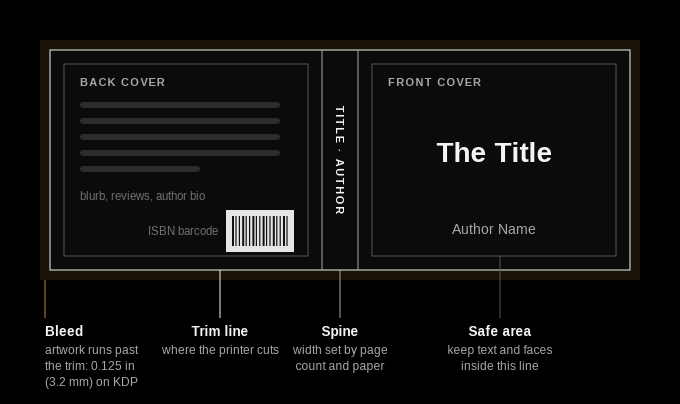
The cover has its own anatomy. On a paperback, the front cover, spine and back cover are printed as one flat sheet that wraps around the pages.
- Hardcovers add a dust jacket, with flaps carrying the blurb and author bio, and endpapers joining the pages to the case.
- The gutter is the inner margin where pages meet the spine.
- Pages are printed on large sheets folded into signatures, usually of 16 or 32 pages, which are then bound together.
- A colophon, traditionally on the last page, describes how the book was made.
On Amazon KDP, a paperback needs at least 79 pages before it can carry text on the spine. Spine width is the page count multiplied by 0.002252 inches for white paper or 0.0025 inches for cream. See book cover design.
Ebooks are different
An ebook has the same parts but treats them differently. Store previews and free samples show the opening of the book, so keep the front matter short and let the story start quickly; many authors move the acknowledgments, dedication and "also by" list to the back. A linked table of contents matters more than in print, because readers use it to navigate. Indexes with page numbers don’t work in reflowable ebooks, so non-fiction ebooks link index entries to the text instead.
What a self-published book needs
- A title page and a copyright page with your ISBN, if you use one. See what is an ISBN.
- A table of contents, linked in the ebook.
- The text, with consistent chapter headings.
- About the author, and an "also by" list once you have more than one book.
- A call to action at the end: your next book, your newsletter or a request for a review.
Everything else is optional. Formatting tools such as Vellum, Atticus and Reedsy’s free editor generate these pages for you. See how to format an ebook and how to publish a book.
Where Ixonian fits in
Ixonian is being built with a Publishing Studio where authors set up their book step by step, from the cover and title to the description and genre, before publishing. Pre-register free.
Frequently asked questions
What order do the parts of a book go in?
Front matter (half title, title page, copyright page, dedication, contents, foreword, preface), then the body (prologue, chapters, epilogue), then back matter (acknowledgments, appendices, notes, bibliography, index, about the author).
What is the difference between a foreword and a preface?
A foreword is written by someone other than the author; a preface is written by the author about how the book came to be.
Where does the copyright page go?
On the back of the title page, the left-hand page that faces the dedication or contents.
Does an ebook need a table of contents?
Yes. Readers use the linked contents to navigate, and ebook stores expect one.